


Mercury Hitches a Ride

Mercury Hitches a Ride
We have known for a long time that mercury likes to tag along with the bits of solids that are a natural part of wastewater. Imagine mercury as the sidecar of a motorcycle. The motorcycle is the solid bit, like a TINY piece of carbon-containing wood pulp for example, and the mercury is hitching a ride. WLSSD has been working hard to remove even the itsy bitsy-est solids from wastewater as part of the treatment process, knowing that the bits will take some mercury with them, and reduce mercury in the cleaned water that is returned to the St. Louis River. And we are doing a good job of it – removing at least 95% of the solids (our permit requires that we remove 85%), and along with that, up to 95% of the mercury that flows to our plant in wastewater.
(Just to be clear, the solids I am talking about are not trash, like rags and plastic gunk. We get that too, but trash is removed first thing and delivered to the landfill.)
The organic solids that can settle out of wastewater, and be removed through filters and other processes in our plant, are what we call Total Suspended Solids (TSS). WLSSD has invested in numerous process refinements and infrastructure improvements that help to further reduce the amount of TSS, and therefore its sidekick mercury, in the final effluent. We have made improvements to our clarifying tanks, so that solids settle out of the wastewater more effectively. We have made changes to our mixed media filters, so as wastewater flows through these filters they can collect more tweeny weeny bits in the filter.
The Blueprint for Mercury Elimination
Furthermore, WLSSD literally wrote the book on mercury pollution prevention programs that have effectively reduced sources of mercury in our community. Our mercury thermometer exchange program is one example of many success stories. We also worked collaboratively with regional dental offices to install special equipment to capture mercury-containing “silver” fillings during dental procedures—the first program like it in the country. Eventually, WLSSD created an ordinance that requires dental offices to use this equipment and similar equipment is now required by the United States Environmental Protection Agency (US EPA) across the country.
After 30+ years of mercury removal efforts, and increasing regulations on mercury limits, we are closing in on our current goal of 1.8 ng/l as a monthly average, and 3.2 ng/l as a daily maximum of mercury in effluent. To get a sense of how small this amount is, consider 1 ng/l as the equivalent to 1 second in nearly 32,000 years; 1 square inch in 250 square miles; and 1 drop of water in about 28 Olympic-sized swimming pools. We are now within 1 ng/l elusive bits of mercury from reaching our goal. Admittedly, we have been a little stumped.
“Green with Algae”: WLSSD’s most recent mercury removal research project
In 2019, WLSSD scientists stumbled across a presentation at a conference about a new technology, the Advanced Biological Nutrient Recovery (ABNR) System, that uses algae to remove phosphorus and nitrogen from wastewater (these nutrients can be problematic for waterways). Our scientists approached Clearas, the technology’s innovators, for a partnership to test out the algae-based process for its potential for removing mercury. Pilot studies onsite with a small side-stream of wastewater through the ABNR system provided proof of concept for mercury removal. This means that while the algae was living its best life soaking up sunshine, and slurping up nutrients in our wastewater, the system was also removing tiny organic bits with mercury attached.
The Clearas system removed enough mercury during the small scale pilot study to bring us below our mercury goals—IF this system could be scaled to handle up to 48.4 million gallons of wastewater every day. A feasibility study is underway that may be able to tell us more about the future of ABNR at WLSSD.
We learned something else really important during the Clearas study. The ABNR system also removed about 30% of the dissolved mercury. Dissolved mercury is a rascal. Dissolved mercury is so small it hitches a ride on particles that can pass through a 0.45 micron filter. Believe me when I say those are the tiniest of TIIIIIIIIIIIIIIINY bits of suspended solids that we can’t capture in our wastewater treatment process. We now know that roughly 60% (it fluctuates) of WLSSD’s total remaining mercury concentration is in the dissolved mercury form, but our plant, like others, is not designed to remove dissolved mercury. We haven’t had the tools for very long to even notice or measure dissolved mercury, that’s how small it is. And now that we can measure it, we need to find ways to remove it and keep it out of Lake Superior.
What does the “color” of wastewater have to do with mercury?
Wastewater, like the water in the St. Louis River, has color. Color is determined by dissolved particles, like reddish/brownish tannins from leaf debris in waterways. During our studies with algae, we noticed a correlation between color in the wastewater and mercury levels. After the wastewater went through the algae system, the water was initially clear-ish, and had virtually “non-detect” levels of dissolved mercury. After several days, the wastewater following the algae treatment had more color. The “colorful” wastewater was associated with measurable amounts of dissolved mercury. This led scientists here at WLSSD to believe that if we can remove color from the water, we may be removing dissolved mercury at the same time. WLSSD is collecting more data on wastewater color and mercury.
A new practice for mercury removal could be a process for removing color. This sounds easier said than done. There are some methods for removing color, like distillation, but for the amount of wastewater we clean every day, it isn’t an option. The algae-based system is exciting, but also a feasibility challenge; it would require new infrastructure, additional land to build that infrastructure, power to run the system, and likely, increased costs to the community. And so the journey continues. WLSSD invites you to jump in the sidecar, and join us on this curious quest for mercury removal—it is sure to be a long and winding road.
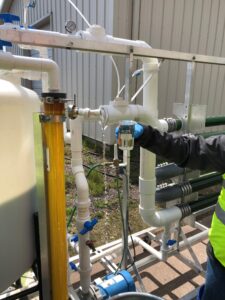
Initially, the wastewater after the ABNR treatment was “clear” and had non-detect levels of mercury.
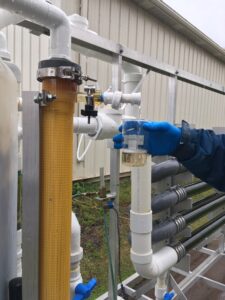
After a period of time, the wastewater leaving the ABNR system had more color, and also had detectable levels of mercury.