


Oil Embargo Lights the Fire for Trash as Fuel

A very brief mention of WLSSD in the Duluth News Tribune’s “Bygones” section, reminded us of an interesting moment in WLSSD’s past that many folks may not be aware of. We decided to dig deeper and share a little bit of this history.
“Bygones: In 1982, WLSSD tried using garbage to burn wastewater sludge”
(By Dave Ouse. Duluth News Tribune, December 6, 2022)
It’s True, and pretty fascinating actually because there is a lot more behind the scenes that lead to the decision to burn trash and wastewater solids (also referred to as sludge) at WLSSD! WLSSD was legislated as a Wastewater Treatment Plant in 1971, followed by the designation as the Solid Waste Authority in 1974. All of this was happening during precarious times for global energy resources.
Does anyone remember the Oil Embargo of 1973? During the Fourth Arab-Israeli War (sometimes remembered as the Yom Kippur War), oil-producing Arab countries banned exports of oil to a number of countries supporting Israel during the war—including the United States. While the embargo on the U.S. was lifted in 1974, the oil-supply crisis that raised gas and oil prices tremendously had already left its mark. The U.S. was faced with reassessing its dependence on Middle Eastern oil. As a result, sweeping changes were made to the domestic energy policy that included an increase in domestic oil production and a focus on energy conservation and efficiency. The impacts of the oil embargo hit close to home – to include the effort to source energy for the 24-hour job of cleaning wastewater!
The drive to be less dependent on imported oil resources resulted in the idea of burning solid waste created by our community as an energy source. When WLSSD opened in 1978, haulers began delivering community solid waste to us to be incinerated in two large incinerators. As long as we were incinerating trash, why not also burn the sludge that is separated from wastewater as part of the treatment process? And that is what we did!
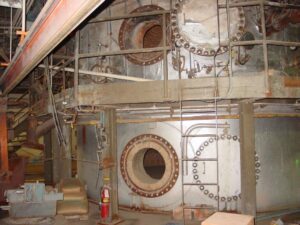
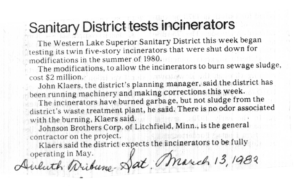
Top left: One of the five-story incinerators used to burn solid waste at WLSSD from 1978 until 1999. Top right: A news article about the use of incinerators for sludge from 1982.
Timeline of WLSSD’s history with wastewater, garbage, and wastewater solids:
1971
The State of Minnesota legislated WLSSD as the Wastewater Treatment Plant for a 530-square-mile district to help restore the St. Louis River from pollution problems and to protect Lake Superior.
1973
The OPEC Oil Embargo inspired greater independence from imported fossil fuels and the potential of solid waste as fuel.
1974
WLSSD was designated as the Solid Waste Authority in our region in order to have a fuel source required for wastewater treatment.
1978
WLSSD started treating wastewater and burned solid waste as a fuel source for this process. WLSSD landfilled wastewater solids for a brief period of time.
1982
WLSSD began using incineration of solid wastes to also incinerate sludge/wastewater solids.
1998-2001
Planning and construction of the solid waste transfer station take place, marking the change from incineration to landfilling in 1999. WLSSD began recycling nutrients in wastewater solids by applying lime-stabilized biosolids on farm fields; lime added to wastewater solids increases pH and reduces biological (pathogen) activity.
2001
WLSSD started using 4 1-million-gallon anaerobic digesters to treat wastewater solids and to produce Field Green® biosolids. This process also generates methane, which we capture and use as biogas that provides heat.
Today
WLSSD cleans about 40 million gallons of wastewater every day.
We take about 16-20 semi-truck loads of solid waste to the landfill in Superior, Wisconsin, every day!
We still use anaerobic digestion of wastewater solids to produce biosolids fertilizer.
We are continually striving to be more energy self-sufficient! In addition to using biogas to generate heat, we will install engine generators that use biogas to generate electricity!
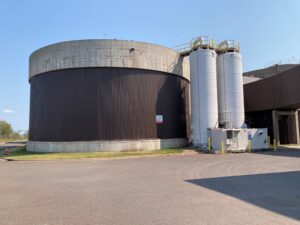
Photo: One of four Aerobic Digesters used to treat wastewater solids—at high temperatures for one month—to become Field Green® biosolids. The white towers in front of the digesters clean the gas released from digestion so it can be used as biogas.
Fun Fact: The oil-supply crisis in 1973 was also the impetus for Daylight Saving Time and a Speed Limit of 55 mph on highways across the country! Nixon signed these two emergency acts in an effort to save on oil usage.