


What Do You Do With 17,000 Busted Beverages?

“I feel like I only ask you really weird questions,” wrote Erin Otis, Production Manager at Vikre Distillery. She reached out to WLSSD’s Environmental Programs team after a batch of their canned cocktails continued to ferment after being packaged into cans. Pressurized to the cusp of bursting, the rock-hard cans presented a problem: they definitely couldn’t be sold, and the prospect of opening every one of the 12,000+ cans by hand seemed overwhelming – let alone potentially hazardous. But if the cans couldn’t be separated from their contents, the whole batch would have to be dumped in the landfill – including the recyclable aluminum cans, high-quality cardboard, plastic film pallet wrap, and reusable wood pallets.
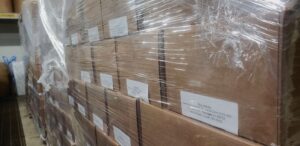
Cocktails, cocktails everywhere, but not a drop to drink.
However, if those materials could be separated and reclaimed, the savings in materials and energy would be sizeable. Aluminum is particularly important to recycle – it can be melted down and reformed into cans or other containers over and over without degrading, and the recycling process requires less than five percent of the energy used to make the original brand-new product. If Vikre’s batch of cans could be emptied and recycled, they could be back on the shelf with new contents in under two months and save enough energy in the process to power your home computer for over four years of 24/7 internet searches for the latest Vikre cocktail recipes and mind-blowing recycling statistics.
So, what DO you do with upwards of 12,000 overpressurized cans? Well, that requires a deep dive into the niche world of beverage destruction. And the best guide you could ask for on that journey is Chris Reinhart. Owner of E-Z Recycling in St. Paul, Chris makes it his business to shepherd misfit products through the final stages of their life and onto the first steps of rebirth as new products. Once upon a time, his business hauled the usual curbside waste. Now he’s specialized as a beverage depackager, with dedicated machinery for ripping open cans and bottles en masse. Those products might be anything from spirits and cocktails to beer, seltzers, sodas, juice, and more. With their cans and bottles sent off for recycling, all that juicy, sugary, boozy product is free to drizzle down into the sewer. But not on Chris’ watch – E-Z recycling sees that waste for what it is: a fantastic food source for methane-producing bacteria. If that waste went through the sewer system to a treatment plant that landfills its leftover sludgy solids, those methane-producing bacterial would expel their potent greenhouse gas farts straight into the atmosphere. However, if processed in the right conditions, that methane can be captured as fuel to produce heat and electricity for homes, businesses, and industries. So, Chris pipes all his rich, juicy beverage waste into tanker trucks and sends them out to anaerobic digestion facilities that do exactly that. Under this beverage destruction model, nothing is wasted.
Now, there was just one more problem: transportation. It turns out businesses like Chris’ are few and far between. In fact, E-Z Recycling occupies such a niche that products are trucked in from across the Midwest for their beverage depackaging services. This complicates things from an energy conservation perspective: is it really better to send a fossil-fueled semi truck over a hundred and fifty miles just to reclaim the energy and materials from four pallets of aluminum cans? Or would it actually be more environmentally sound in the long run to let this batch go to landfill and keep transportation energy costs and greenhouse gas emissions at a minimum?
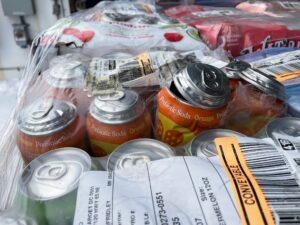
Aluminum cans didn’t stand a chance against Minnesota’s cold weather.
While Erin and the staff at Vikre pondered this question, the year’s first big winter storm settled in. Everything ground to a halt under a blanket of snow and plummeting temperatures. Then, after shoveling out from the drifts, the Northland took stock of the storm’s effects. One unusual casualty? A truckload of sodas, sports drinks, fruit pouches, juices, and other beverages that froze before they could be unloaded into the climate-controlled safety of a Hermantown big box store. Twin Ports Trailer Trash took on the job of making the frozen, partially-exploded, totally-unsellable beverages go away. Now, they were out of sight and out of mind for the retailer, but Twin Ports Trailer Trash’s work had just begun. Unusual, bulky, heavy, gross waste was nothing new for TPTT, but this batch gave them pause. They reached out to WLSSD with the same question as Vikre – should they bring it to WLSSD’s transfer station and have it send off to the landfill? Or was there a better solution?
As it turns out, two unlucky coincidences make one lucky coincidence. If both the overpressurized cocktails and miscellaneous frozen beverages were sent to St. Paul together in one truckload, the environmental costs of transportation would be essentially cut in half. By the end of the week, all those beverages – eight pallets full, or about 17,000 cans and bottles in total – were en route for St. Paul and well on the way to becoming recycled cans, bottles, and more.
It would have been all too easy to let these materials go to waste in a landfill. WLSSD is proud to celebrate the care, determination, and ingenuity that gave them a second life.
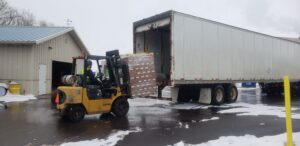
WLSSD staff load the cans for transport to E-Z recycling.