


Ready to reduce PFAS in your home? Five steps to a healthier household
Per- and Polyfluoroalkyl Substances (PFAS) have been widely used in household products for decades. Research is providing good reason to reduce exposure to PFAS—for our health, and for the environment. In this article, we’ll recommend five actions for identifying and reducing the use of PFAS-containing products in your home. But first, let’s dig a little deeper into what PFAS are, why they are problematic, and what the state is doing to address them.
What are PFAS?
PFAS are a family of over 5,000 human-made chemicals. The signature feature of all PFAS molecules is the carbon (C) and fluorine (F) bond; a bond that is nearly unbreakable. PFAS are known as the “forever chemicals” because they persist and accumulate over time.
Manufacturers have used PFAS for creating “slippery” surfaces that resist water, heat, stains, and grease. This is why they have been useful in a wide assortment of products in our homes, including food packaging, waterproof clothing, carpeting, cosmetics, shampoo, non-stick cookware, paper plates, and even dental floss.
Why are PFAS a problem?
Scientists have been able to more accurately measure PFAS in recent years and are learning just how prevalent they are. On top of that, some studies have linked certain types of exposure to PFAS with adverse health effects.
According to the Center for Disease Control and the Agency for Toxic Substances and Disease Registry, people can be exposed to PFAS from public and private drinking water; food that was in contact with PFAS-containing packaging or sourced from contaminated water or soil; and consumer products including furniture, carpeting, clothing, personal care products, cosmetics, stains, and varnishes.
Way to go, Minnesota—making strides in identifying and reducing PFAS pollution!
Timeline for selected actions:
2020. Minnesota Legislation prohibited the use of PFAS-containing firefighting foam for testing and training, and now in 2024, also prohibits use in incident response with some exceptions (Minn. Stat. § 325F.072).
2021. The Minnesota Pollution Control Agency published the Minnesota PFAS Blueprint—a plan to prevent, manage, and clean-up PFAS. The plan prioritizes pollution prevention and calls for regulation and legislation.
2024. Legislation prohibits the intentional use of PFAS in food and beverage packaging, in effect January 1, 2024 (Minn. Stat. § 325F.075).
2025. Legislation is being implemented that will ban intentionally added PFAS in the manufacturing, distribution and sales of eleven product categories: carpets and rugs, cleaning products, cookware, cosmetics, dental floss, fabric treatments, juvenile products, menstruation products, textile furnishings, ski wax, and upholstered furniture (Minn. Stat. § 116.943, Subd. 5a).
2025. The Minnesota Department of Health (MDH) intends to test community drinking water sources for PFAS across the state by 2025, but this does not include private wells unless in an area of known contamination. The MDH tested both Lake Superior and Duluth’s treated drinking water for certain PFAS compounds in 2019 and none were detected. Testing of Duluth’s treated water in 2023 gave similar results.
2026 Manufacturers must report products containing intentionally added PFAS (Minn. Stat. § 116.943, Subd. 2).
2032. Legislation ending all avoidable PFAS use in Minnesota goes into effect in 2032.
PFAS concentration ranges in common consumer products
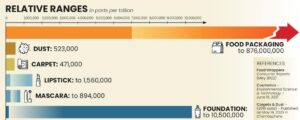
Modified and used with permission from the Metropolitan Water Reclamation District of Greater Chicago (MWRD). Image credit to MWRD, California Association of Sanitation Agencies, and the research studies referenced on the graphic.
Five action steps for reducing PFAS in your home
Although progress has been made at the state level to reduce manufacturing, distribution, and use of PFAS-containing products in Minnesota, we may still be exposed to PFAS in our homes and can make informed consumer decisions until the laws are solidly in place. To reduce exposure to PFAS in your home, consider the following action steps:
- Swap out non-stick cookware for pans that are PFAS-free. Using PFAS-containing non-stick pans at high temperatures, and scratching the non-stick surface with metal utensils, can cause the PFAS coating to contaminate food. To prevent this, choose stainless steel and cast-iron pans or non-stick alternatives that are intentionally PFAS-free. Look for “PFAS-free” on labels and advertisements.
- Review and reduce the use of food contact materials and packaging containing PFAS— while reducing potential exposure to PFAS, you’ll also reduce waste! Three places to start:
- Make the transition from microwavable popcorn bags to popcorn that is cooked on the stove (in a PFAS-free pot!) or in a reusable glass or silicone microwavable container designed for popcorn.
- Buy foods in grocery stores and restaurants that are packaging-free as often as possible. Consider using reusable to-go containers when carrying out left-overs from restaurants. You can also rethink your fast-food choices—research has shown that some fast-food wrappers can pack a punch of grease-resistant PFAS.
- Phase out paper plates and cups and make the switch to reusable serve ware. It may mean a little more time washing dishes, but it’s a safer choice.
- Learn more about household products that may contain PFAS and how to identify them. Resources online, such as the Environmental Working Group, list businesses that have made a commitment to sell PFAS-free products, in either all or some on their product lines. As you shop for products in stores, like cleaning supplies or shampoo, read the label and look for ingredients that have “fluorinated” or fluoro” in their names—these ingredients may be a part of the PFAS family. Water-resistant cosmetics like mascara and foundation are likely to contain PFAS and might be good to avoid until the new law takes effect in 2025.
- Research your drinking water sources. If you have a public drinking water source, check with your public utility to see if they have tested for PFAS or have a plan for management (remember that Duluth’s water has already been tested and PFAS were not detected). If you have a private well and are interested in having it tested, the MDH lists seven approved labs that will test homeowners’ well water, although testing may take some time and can be costly. Cost-effective water filters are available that are certified to lower levels of PFAS. For more information, visit the Environmental Protection Agency and the MDH.
- Stay up to date on fish consumption advisories. In 2021, Wisconsin issued a fish consumption advisory for smelt after finding a limited number of fish near the Apostle Islands and Port Wing that contained high levels of PFAS. The advisory recommends limiting consumption of smelt to one meal per month. Minnesota followed suit and also issued an advisory for smelt based on Wisconsin’s findings. A good resource for fish consumption advisories is the Minnesota Department of Natural Resources website, “Lake Finder”, as well as the MDH PFAS in Fish webpage.
For additional information, consult these helpful resources:
- Meaningful and Achievable Steps You Can Take to Reduce Your Risk | US EPA
- Minnesota’s PFAS Blueprint | Minnesota Pollution Control Agency (state.mn.us)
- Per- and Polyfluoroalkyl Substances (PFAS) – MN Dept. of Health (state.mn.us)
- A Guide to Reduce PFAS Exposure in the Home – WLSSD