


A New Era For Our Region’s Trash
A Brief History
Resource Renew’s water resource recovery facility was the first co-disposal facility in the nation, incinerating wastewater solids with trash as the fuel source. The District received legislative authority over the region’s solid waste in 1974. The incinerators came on line in November 1979 and operated for twenty years.
The incinerators were reaching end-of-life by the late ‘90s. Staff determined the wastewater solids were too valuable to incinerate. The anaerobic digestion system was constructed to treat and produce a nutrient-rich biosolids fertilizer.
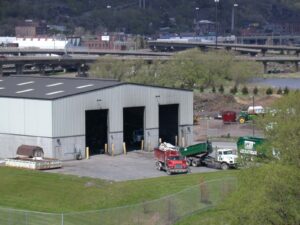
Resource Renew Solid Waste Transfer Station
The Solid Waste Transfer Station was built in 1999 as the incinerators were shut down. The District has sent over 90,000 tons of trash to the City of Superior Landfill each year. However, that landfill is full. The region’s trash is now hauled to the St. Louis County Regional Landfill in Virginia. About twice the number of trailers are required to transport the daily tons of trash almost 68 miles to its final destination.
Due to the longer travel distance for the region’s trash, the average increase for residential service is expected to be approximately $0.48 per pickup.
Design Overview
The Solid Waste Transfer Station was built in 1999 to manage 60,000 tons of waste per year. It was originally constructed for $1.83 million:
- Assumed 40 garbage trucks delivered trash daily (peak 60)
- Assumed 11 semi-trailer loads hauled to the landfill daily (peak 20)
Currently, 90,000 tons flow through annually with $17.8 million needed to expand the site for continued growth.
What We Do to Reduce Waste and Cost
The District works to divert resources on site before anything is transported to the landfill. More resources are expected to be recovered and recycled each year.
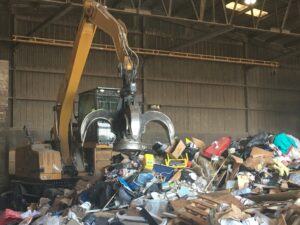
Grapple that sorts metal at the Transfer Station
Resources recovered in 2025 were:
- 254 tons ferrous scrap metal
- 3 tons non-ferrous scrap metal
- 30 tons pallets
A Closer Solution
St. Louis County is working to develop a new solid waste facility in Canyon. Those plans hinge on continuing good faith efforts to reduce the amount of valuable resources in the trash and mutual District and St. Louis County lobbying efforts at the Capitol.
What You Can Do to Reduce Waste and Cost
Residents can help reduce waste and cost in several ways.
Right-Size Service
Volume-based pricing is used to determine what each resident pays for trash service. The size of the cart and how often it gets emptied determines the monthly rate. Notice how full (or empty) your cart is and consider adjustments to ‘right-size’ your service.
Food Scrap Diversion
- Use a backyard compost bin to keep fruit and vegetable scraps out of the trash.
- Get a free food scrap bucket and bring food scraps to a neighborhood drop site for composting at Resource Renew.
- Learn waste prevention tips to properly store and use food before it becomes waste.
Film Plastic Recycling
The Materials Recovery Center and Household Hazardous Waste Facility, nine rural recycling sites, and several area stores have containers for film plastic recycling.
Clean and dry single-use plastic grocery and retail shopping bags can be recycled. Sort and recycle these bags and other film wrap:
- produce & bulk food bags
- bread & bakery bags
- case wrap (from things like water bottles, soda cans, paper towels, etc.)
- dry cleaning bags
- bubble wrap & air pillows
- resealable food storage bags
Efficient Household Recycling
Take advantage of the recycling cart and make sure all the recyclables end up there and not in the trash. To-go paper and plastic cups and cartons can now be recycled.
What’s Next?
The District participated in a statewide waste characterization study in 2025 and early 2026. The results of the study will help guide future waste reduction efforts.
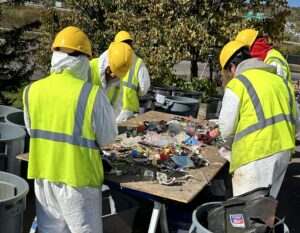
Sorting EVERY bit of waste