


What to do with food scraps? Part 2: Raising a Feathery Flock of Food Scraps Consumers
By now, you may be familiar with several options to use your food scraps in useful ways, and to keep them out of the landfill—where the rascally scraps cause a bit of trouble by creating greenhouse gases as they decompose.
If you haven’t found the right solution for your food scraps management plan yet, don’t fret because today’s suggestion is sure to get your feathers fluffed with excitement!
Did you know that you can raise chickens in the City of Duluth and other residential neighborhoods? By following a few simple rules, you can keep chickens in your yard as food scrap feeders, egg layers and best of all…pets. Chickens have amazing and unique personalities. If socialized with humans when they are young, some breeds can be quite…well…uhm…“snuggly”.
Let’s start with some of the rules. The City of Duluth requires that you submit an application for a license to keep chickens, and pay a small fee. The license also details the ordinance and defines the City’s rules about raising chickens. The ordinance includes coop and fencing requirements, which are very reasonable and encompass everything your chickens need to be safe, healthy and protected. Oh, and there are also some rules for keeping your nearest neighbors happy, too. The City allows a flock of up to 5 hens in its residential neighborhoods, more in suburban areas. Your flock cannot include a rooster because of noise issues (they are the ones who do the early morning cock-a-doodle-doo-ing). And, you don’t need roosters to get eggs! Let’s talk about that…
Hens lay eggs, depending on the breed, every other day or so (fewer eggs in winter, and for a limited number of years). The rooster’s job is to fertilize the eggs so they have the potential to become chicks. Let’s do the math on the “birds and the bees” when it comes to chickens:
Hen + Rooster = eggs, when incubated, can hatch out chicks
Hen – Rooster = eggs, no hatching, no chicks, just breakfast!
You’ll need to invest in a coop, whether buying or building. Some things you’ll want to consider for your ‘flock footage’ include a secure enclosed indoor space for sleeping at night with insulated walls for winter months, roosting stick, nesting boxes, waterer, feeder, and a predator-proof outdoor run (fenced in and covered with mesh). Chickens use the nesting boxes (small, cozy, box-like areas) in the coop to lay eggs; these are often times built on the side of the coop, and can be accessed from the outside for easy egg collection. For winter months, you’ll need to have a heater for the waterer and a heat lamp or other heat source for the chickens. It is simply amazing how winter-hardy chickens manage our sub-zero temps, sometimes with a frost-bitten comb—but a little extra heat can make all the difference.
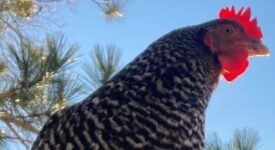
Research which breeds will suit your needs. Some breeds are more docile, some are more prolific layers, and definitely take a look at the winter-hardy breeds. My personal favorites are Brahma and Barred Rock for many reasons, but a few include temperament, winter-hardiness, and appearance. Brahmas have gloriously feathered feet that remind me of slippers (pictured below), and Barred Rocks are a lovely salt and pepper coloration (feature picture). The spectrum of egg colors is like walking into the paint isle at your favorite hardware store: Blues, greens, pinks, beige, brown, speckled – and let’s not forget to mention the yolks, which are an unbelievably deep orange, like a Minnesota sunset.
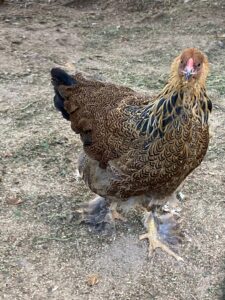
This is a teenage Brahma, notice the feathery feet.
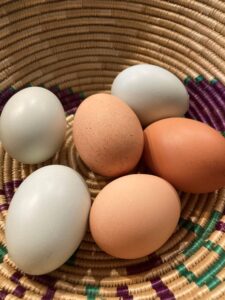
Check out the variety in these eggs from 4 different breeds: Brahma, Barred Rock, Ameraucana, and Astralorp.

The vibrancy in these yolks also hints at the depth of flavor.
I brought home some chicks, now what? You’ll want to keep days-old chicks indoors in a bin with a heat lamp and bedding. Chicks need to be toasty warm, but they also need to have space to leave the heat source as needed. When you first get them home, dip their beaks in their water bowls which may encourage them to drink. You’ll start out with a purchased “starter” feed mix designed for baby birds, and when that that bag is gone, they may be ready for feed for growing birds. Over time they’ll develop a fully feathered coat and can then can be moved out to the coop. If you buy pullets (teenage chickens, 4-17 months old) they likely can be in the coop from the get-go. After the first egg appears (depending on the breed, about 16-18 months), you’ll switch to “layer” food.
Food Scraps!! You can start adding food scraps to the diet of teenage birds (~4 months old), just make sure they have access to their feed as well to help their bodies develop everything they need for laying eggs. When you bring them some tasty treats like watermelon rinds, corn on the cob, peppers, bread, meat bits -you name it- they’ll eat it. And, they can eat ALL THE SCRAPS! They will come running to greet you in anticipation of what’s the Snack De Jour – Grapes? Oatmeal? Greens? One of my favorite foods for the chickens is leftover spaghetti, because they slurp up the noodles just like we do sometimes – one long squiggly noodle at a time. Consider chopping up the scraps for easier access. Eggshells, crushed and maybe even cooked, will help chickens get calcium, along with calcium-containing products you can purchase. They also need grit for their gizzard, and may be able to get this from their yard space.
Bedding. Wood shavings make for great bedding in the coop. I recommend some monthly maintenance cleaning to reduce odors; this would include removing clumps and adding fresh bedding. The bedding and waste will break down in the coop over time, and some folks just add fresh bedding over the old bedding. If you take the old out, you can compost it, and add it to your garden as a soil amendment.
If you like the idea of exchanging food scraps, a little yard space, and some TLC, for some entertaining chicken antics and eggs, then raising chickens might be the food scraps management plan for you!
Recommended resources for information on raising chickens:
BackYard Chickens – Learn How to Raise Chickens
Harvey Ussery. The Small-Scale Poultry Flock. An all-natural approach to raising chickens and other fowl for home and market growers. Chelsea Green Publishing. 2011.
Gail Damerow. Storey’s Guide to Raising Chickens. Storey Publishing. 2010, 2005. 3rd Ed.