


EPA and MPCA Release Updates on PFAS

EPA Releases Draft Risk Assessment on PFAS in Biosolids and MPCA releases Minnesota Biosolids PFAS Strategy
What It Means for WLSSD and the Community
The Environmental Protection Agency (EPA) recently released a draft risk assessment evaluating potential health and environmental risks associated with two specific chemicals that can be found in biosolids: PFOA and PFOS. These chemicals are part of the larger family of Per- and Polyfluoroalkyl Substances (PFAS), widely used in products like non-stick cookware, firefighting foam, water-resistant fabrics, cosmetics, and food packaging.
Studies link increased exposure to PFAS with adverse health effects, underscoring the importance of reducing exposure wherever possible. To learn more about minimizing PFAS exposure, visit our past blog post.
Wastewater Treatment and PFAS: The Connection
At WLSSD, we treat wastewater from homes, businesses, and industries using advanced biological processes that mimic nature’s ability to clean water. This process produces three key end products:
- Clean Water: Safely discharged into the St. Louis River.
- Methane Gas: Used onsite to generate heat and electricity, reducing energy costs.
- Nutrient-Rich Biosolids: Beneficially applied to farmland and mine tailings basins to promote crop growth and ecological restoration. Did you know? In Minnesota, less than 0.1% of cropland receives biosolids.
PFAS enter the wastewater stream from everyday products and activities. Unfortunately, current technology cannot completely remove PFAS during treatment, so small amounts may remain in the water or biosolids.
Key Findings from the EPA Assessment
The EPA’s draft assessment modeled potential risks to a hypothetical “farm family.” This scenario assumes the family:
- Lived on the farm for 10 years
- Consumed most of their food from crops or livestock raised on that land.
Additionally, the model assumed the farmland received biosolids each year for 40 years.
EPA’s draft risk assessment found that PFAS in biosolids does not present a risk to the general public or food supply but may present a risk to the farm family that was modeled. It is also important to put the risks associated with PFAS in biosolids into perspective as the amount of PFAS typically found in biosolids is much lower than what is found in many common household products. To reduce risk of exposure from everyday products, the Minnesota Legislature passed Amara’s Law that now prohibits intentionally added PFAS in certain product categories.
The draft assessment does not propose new regulations but lays the groundwork for additional research and data collection to determine what the appropriate standard should be.
WLSSD’s Commitment to Safety and Compliance
WLSSD’s land application of biosolids is regulated by the Minnesota Pollution Control Agency (MPCA) and the Wisconsin Department of Natural Resources (WDNR). WLSSD’s biosolids consistently meet the strictest regulatory thresholds in both Minnesota and Wisconsin’s regulations, ensuring land application in compliance with state guidelines. The MPCA and WDNR are actively addressing PFAS in biosolids through new strategies:
- MPCA: Released “Minnesota Biosolids PFAS Strategy,” in January 2025.
- WDNR: Released “Interim Strategy for Land Application of Biosolids and Industrial Sludges Containing PFAS” in 2024.
Both strategies require PFAS sampling and emphasize source identification and reduction efforts to minimize PFAS levels in biosolids. A tiered approach is used to monitor PFAS and mitigate risk while still promoting the use of biosolids for beneficial reuse. Below shows the tiered levels for Wisconsin and Minnesota.
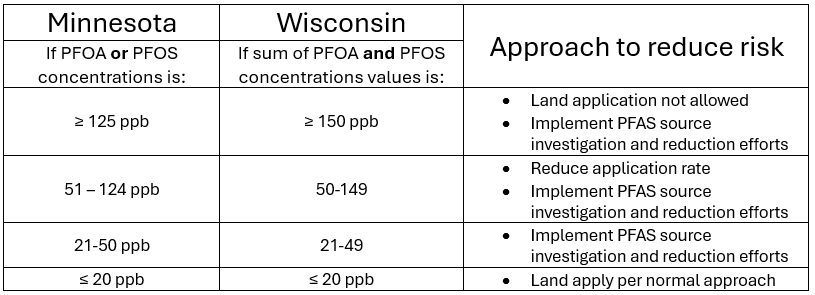
WLSSD regularly samples the water coming into the facility (influent), the water exiting the facility (effluent) as well as the biosolids. These samples are then sent to certified labs that can run the samples to test for PFAS. Results can be found on our website and consistently show low levels of PFAS that place WLSSD in the lowest tier for both Minnesota and Wisconsin guidelines.
Looking Ahead
The risk assessment has been released in draft form and it is subject to public review and comment, including challenges to its scientific and technical bases. It is possible that EPA may refine the risk assessment findings based on feedback or decide not to finalize it at all. No complete conclusions about the risk assessment or its findings can be made unless/until it is finalized.
WLSSD remains committed to protecting public health and the environment. We will continue monitoring PFAS developments, adhering to evolving regulations, and collaborating with regulatory agencies to ensure the responsible management of biosolids.
For questions or to learn more about WLSSD’s biosolids program, please visit our website or contact us directly.
Resources:
EPA Draft Risk Assessment Website
EPA Draft Risk Assessment Fact Sheet
MPCA PFAS in biosolids strategy
Interim Strategy for Land Application of Biosolids and Industrial Sludges Containing PFAS