


Recycling: Is it Real?
Whenever I introduce myself as a recycling educator, I know what question is coming next. My new acquaintance will lean in close, look around to see if anyone is watching, and whisper: “So is recycling actually… real?”
I don’t know any other kinds of educators who get asked that question. Nature educators don’t get asked “is nature real?” Gym teachers don’t get asked “is gym real?” But with all the headlines about trash in the oceans, misleading product sustainability labels, and microplastics in, well, everything, I understand why they ask about recycling.
I start by answering simply: Yes.
Recycling is real.
We can see the evidence in the robust economy of products made from recycled materials. We can see the evidence in the careers and facilities built around transporting, sorting, and processing everything we throw in our recycling bins. Plus, it’s the law.
In the state of Minnesota, it’s illegal for the recyclables you separate to end up in the trash. And in the Resource Renew region, our own Solid Waste Ordinance echoes and strengthens that bottom line. If reading dense legalese isn’t your idea of a good time, here’s the basics: if you separate your recyclables from your household trash, it’s illegal for them to be incinerated, tossed in a landfill, or damaged beyond the point of recyclability. Your recyclables have to go someplace that will sort and process them so that they can be recycled into new products. If your recycling bin is too contaminated with trash and can’t be recycled, the collector has to let you know so that you can learn to do better.
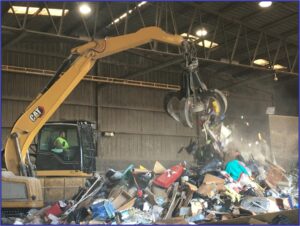
“The Claw” sorts through all our region’s trash to look for recyclables and other unacceptable wastes.
But how do we know that the law is being followed? Honestly, it’s simple. Every collector who picks up trash in our region has to bring everything to Resource Renew’s transfer station. There, every garbage truck and every dumpster gets dumped out on the concrete floor for inspection. The inspector (and their giant version of an arcade claw machine) digs through every pile of trash to look for stuff that doesn’t belong. They check for hazards like tires and major appliances (which can leach harmful substances into a landfill), batteries and vehicle fluids (which could combust and cause landfill fires), yard waste (which belongs at the Yard Waste Compost Site), and recyclables.
The inspector also looks for materials that are acceptable in the trash but could still be used for a better purpose. Using a giant magnet, they separate scrap metal for recycling at a foundry. They also separate clean wood, like broken pallets, to be turned into fuel or wood chips.
But what happens when they find something that doesn’t belong?
Some unacceptable materials, like tires and refrigerators, are easy to spot and set aside for proper disposal. Others, like rechargeable batteries, are harder to spot but equally important to keep out of the trash. Recyclables, though, are a whole different story. Once they get contaminated by juicy garbage, they’re not suitable for recycling and have to go to the landfill. That’s why it’s so important to separate recyclables at home: no one else will be able to pull them out later!
But the story doesn’t stop there. Though we can’t save the recyclables that get mixed with trash, we take our ordinance seriously and work to prevent recyclables going into the trash in the first place. If a garbage truck does drop off a significant quantity of recyclables, that hauling company has to pay fees and fines. We’re not just here to hand out punishment, though. We work with haulers (and businesses, and schools, and landlords, and community groups, and residents) to help everyone understand the rules and why they’re important.
And why is recycling important?
The reasons are more obvious than ever now that the local landfill (Moccasin Mike landfill in Superior – did you know that’s where your trash goes?) is almost full. By summer of 2026, there won’t be any more room, and that landfill will officially close. After that, all our region’s trash will be trucked to the landfill in Virginia, Minnesota. That’s a lot further than Superior, which means a lot more mileage, a lot more fuel cost, and a lot more time and energy moving our trash around. Today, our region sends about sixteen semi trucks worth of trash to the landfill every day, six days a week. Our community has done a lot of work over the years to bring that number down, but there’s still more work to do. And every time we recycle – and trust in the recycling system – we’re taking a step in the right direction.