 Todays Hours


All Hours:
- Monday: Closed
- Tuesday: Closed
- Wednesday: 8:00 am - 4:30 pm
- Thursday: 8:00 am - 4:30 pm
- Friday: 8:00 am - 4:30 pm
- Saturday: 8:00 am - 4:30 pm
- Sunday: Closed
Holidays Closed:
- New Years Day
- Martin Luther King Day
- Presidents Day
- Memorial Day
- Juneteenth
- Independence Day
- Labor Day
- Indigenous Peoples Day
- Veterans Day
- Thanksgiving and Day After
- Christmas Eve and Christmas Day
All Hours:
- Monday: Closed
- Tuesday: Closed
- Wednesday: Closed
- Thursday: 8:00 am - 4:30 pm
- Friday: 8:00 am - 4:30 pm
- Saturday: 8:00 am - 4:30 pm
- Sunday: Closed
Holidays Closed:
- New Years Day
- Martin Luther King Day
- Presidents Day
- Memorial Day
- Juneteenth
- Independence Day
- Labor Day
- Indigenous Peoples Day
- Veterans Day
- Thanksgiving and Day After
- Christmas Eve and Christmas Day
All Hours:
- Monday: Closed
- Tuesday: Closed
- Wednesday: 8:00 am - 4:30 pm
- Thursday: 8:00 am - 4:30 pm
- Friday: 8:00 am - 4:30 pm
- Saturday: 8:00 am - 4:30 pm
- Sunday: Closed
Holidays Closed:
- Memorial Day
- Juneteenth
- Independence Day
- Labor Day
- Indigenous Peoples Day
- Veterans Day
All Hours:
- Monday: 8:00 am - 4:30 pm
- Tuesday: 8:00 am - 4:30 pm
- Wednesday: 8:00 am - 4:30 pm
- Thursday: 8:00 am - 4:30 pm
- Friday: 8:00 am - 4:30 pm
- Saturday: Closed
- Sunday: Closed
Holidays Closed:
- New Years Day
- Martin Luther King Day
- Presidents Day
- Memorial Day
- Juneteenth
- Independence Day
- Labor Day
- Indigenous Peoples Day
- Veterans Day
- Thanksgiving and Day After
- Christmas Day
Recycle Your Household Food Scraps
Residents in the region can save money and reduce the amount of waste going to the landfill by recycling food scraps. Food waste in landfills produces methane, a potent greenhouse gas. Food waste that is carefully composted produces a natural, humus-like product that is a valuable soil amendment.
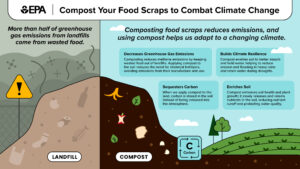
Image credit: Environmental Protection Agency
Resource Renew’s free Food Scrap Drop Sites
Collect kitchen scraps in compostable bags and deliver to several free drop sites located throughout the region. Drop site users find their household trash is greatly reduced (and smells a lot better too).
Free compostable bags are available from Resource Renew at the Materials Recovery Center, Household Hazardous Waste Facility, Yard Waste Site, and at the Administrative Offices, and most food scrap drop sites. You can also purchase bags at many retailers locally. Just be sure the bags you use are certified compostable and carry the seal of the Biodegradable Products Institute (BPI).


What’s the best set-up to collect food scraps in my kitchen? There’s no single right answer, but these tips should get you started collecting food waste:
- Use a covered container that still allows for air flow, such as an ice cream bucket with loose fitting top or air holes punched in the cover. Many companies make nice-looking, functional compost collectors that sit on the countertop with style.
- Right-size the container to fit your needs. Food scraps should be brought to a drop site or added to your own compost bin regularly to avoid odors and pests.
- Use the refrigerator and/or freezer to store food scraps if you can’t get to a drop site before it becomes a nuisance.
What kind of scraps can I put in the residential drop sites?
Our drop sites accept anything that is or was edible: raw and cooked food, meat, fish, small bones, spoiled/moldy food, fruits, vegetables, peels & pits, cheese, breads, dough, pasta, rice, old pet food, tea bags, coffee grounds & filters. We also accept compostable serve ware that has been BPI-certified (see next paragraph); look for the logo on packaging and the product itself. We do not accept food wrappers, pet waste & kitty litter, diapers & hygiene products, dirt & rocks, yard waste, pizza boxes, napkins, paper towels, paper plates and cups, and liquids.
No napkins, paper towels, and paper plates…Oh, why?
Paper and other fiber products are generally considered part of the organics waste stream, but there’s a catch! Some paper/fiber products, serve ware, and other food contact materials can contain coatings and additives that are water and grease resistant chemicals called PFAS, Per- and Polyfluoroalkyl Substances. These synthetic chemicals have been used for decades in helpful products including non-stick cookware, fire-fighting foam, dental floss, shampoo, water-resistant clothing, and so much more. The scientific community is still learning about PFAS—its persistence in the environment and associations between PFAS exposure and health impacts. It can be challenging to discern what products contain PFAS so changes have been made to limit the feedstocks in our compost process to food scraps, yard waste, and BPI-certified compostable products. Why BPI products? The Biodegradable Products Institute is committed to only certifying products as compostable if PFAS isn’t used in their formulations. These efforts are in place to create a high-quality compost. As the science develops, and as new laws banning the use of PFAS in certain products are solidly in place, updated best practices may emerge.
DIY Backyard Composting
Keep your fruit and vegetable scraps to mix with yard waste in your own backyard and create your own custom compost! Please review city ordinances for your area before getting started. The City of Duluth Composting Regulations can be found here: Chapter 24 – Garbage and Other Solid Waste | Legislative Code | Duluth, MN | Municode Library